

A road pavement refers to the different layers of material used to support traffic loading. Historically, pavements have been divided into two broad categories namely flexible and rigid pavements. These pavements differ in their composition, construction, and performance. Understanding the differences between these two types of pavements can help us make informed decisions when designing, constructing, and maintaining our transportation infrastructure.
Flexible Pavements
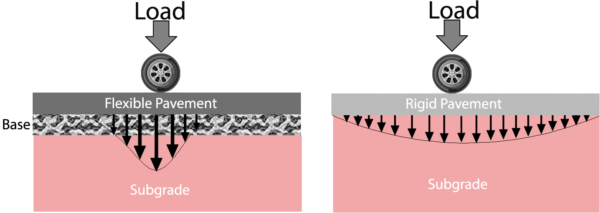
Flexible pavements are designed to distribute loads over a greater depth, and they are made of several layers of materials. Generally, these layers are the subbase, base, and surfacing. The load-carrying capacity of a truly flexible pavement is brought about by the load-distributing characteristics of the layered system. The strength of a flexible pavement is the result of building up thick layers and, thereby, distributing the load over the subgrade. The weakest materials are laid at the very bottom whereas the more durable materials are laid at the very top to ensure the structural integrity and adaptability of the entire structure.

Different materials are used in the construction of a flexible pavement, with the subbase layer mainly composed of natural gravel which might or might not be improved (with cement or lime). The base layer might also be made up of similar natural gravel material as the subbase, but also crushed stone, an asphalt mix or concrete. The surfacing layer in a flexible pavement structure is generally a thin layer of asphalt mix, with chippings sometimes applied on this surface, technically referred to as surface dressing. The choice and thickness of the material is guided by the level of traffic loading expected on the pavement and the strength of the underlying subgrade.
Advantages of Flexible Pavement
One of the key advantages of flexible pavements is their ability to accommodate movements caused by changes in temperature and moisture content. This flexibility allows the pavement to expand and contract without cracking, which makes it more durable and less prone to damage. Additionally, flexible pavements are generally less expensive to construct than rigid pavements.
Disadvantages of Flexible Pavement
However, flexible pavements also have some disadvantages. They are more prone to rutting and deformation under heavy traffic loads, and they require more frequent maintenance and repairs. Additionally, they have lower load-carrying capacity than rigid pavements, which limits their use in certain applications.
Rigid Pavements
Rigid pavements, also known as concrete pavements, highly depend on the concrete layer to carry the traffic loading, distributing loads over a significantly wider area than flexible pavements do. Rigid pavements depend on the bending action of the concrete slab. Rigid pavements also have a longer service life than flexible pavements, and they require less maintenance and repairs over their lifespan.
As most of the traffic loading in a rigid pavement is carried by the concrete slab, the underlying subgrade characteristics have little significance on the load-bearing capability of the pavement. However, when constructing a rigid pavement, it is advisable to include a base course under the concrete pavement. The base course serves the following functions:
- Control of bumping,
- Control of frost action,
- Drainage,
- Control of shrink and swell of the subgrade, and
- Expedition of construction
The base course lends some structural capacity to the pavement. However, its contribution to the load-carrying capacity may be relatively minor.
Advantages of Rigid Pavement
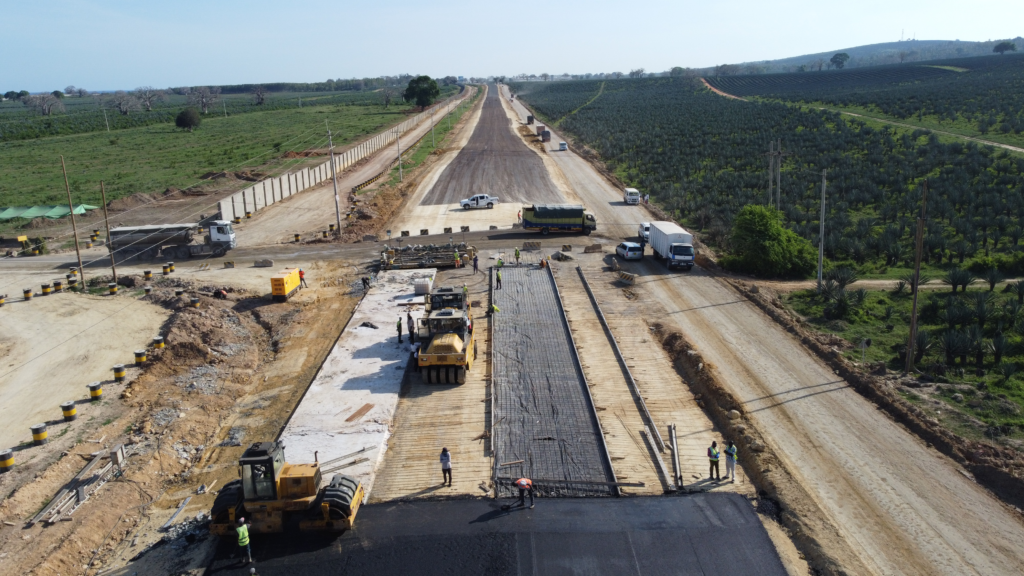
One of the key advantages of rigid pavements is their high load-carrying capacity, which makes them suitable for heavy industrial applications and high-traffic areas. They also have a higher resistance to rutting and deformation, which makes them more durable and less prone to damage. The cover photo shows a section of the Mombasa – Kwa Jomvu Highway (A109) in Kenya. The road serves as a major evacuation artery from the port of Mombasa, serving the larger East and Central African Region. As such, the carriageway leading out of Mombasa (Left Hand Side) has been constructed using a rigid pavement, to carry the heavier truck loads leaving the port. The carriageway to the right serves traffic getting into Mombasa, comprised mostly of unloaded trucks, which can easily be carried by a flexible pavement.
Disadvantages of Rigid Pavement
However, rigid pavements also have some disadvantages. They are more expensive to construct than flexible pavements, and they are less suitable for areas with high soil moisture content or expansive soils, as these conditions can cause cracking and damage. Additionally, rigid pavements are more prone to damage from heavy freeze-thaw cycles, which can cause cracking and spalling.
Comparison Between Flexible and Rigid Pavements
The following table summarizes the major differences between flexible and rigid pavements, as discussed in the preceding sections:
| Property | Flexible Pavement | Rigid Pavement |
| Material Composition | Multiple layers of gravel and bituminous materials and aggregates | Single layer of cement concrete |
| Load Distribution | Distributes load over a great depth. Depends on grain to grain load transfer. | Distributes load over a wide area. Depends on the bending/beam action of the concrete slab. |
| Load Capacity | Low load-carrying capacity. | High load-carrying capacity |
| Maintenance | Requires frequent maintenance and repair | Requires less maintenance and repair |
| Cracking | May experience cracking due to temperature changes and heavy loads | May crack due to shrinkage or expansion of concrete |
| Resurfacing | Can be easily resurfaced | Difficult to resurface |
| Cost | Generally less expensive than rigid pavement | Generally more expensive than flexible pavement |
A graphical representation of the loading scenarios for flexible and rigid pavements is shown below:
Choosing between Flexible and Rigid Pavement
Choosing between flexible and rigid pavements depends on a variety of factors, including traffic loads, soil conditions, climate, and budget. In general, flexible pavements are suitable for low to medium traffic loads and areas with high soil moisture content or expansive soils. Rigid pavements are suitable for high-traffic loads and areas with stable soils and dry climates.
Rigid pavements are also used on roads where a huge number of slow-moving heavy trucks will be experienced, such as climbing sections on relatively flat terrains. Concrete pavements are also installed on weighbridge lanes whereby a heavy concentration of heavy trucks is expected. Further, rigid pavements are installed on junctions to establishments serving a majority of heavy trucks. Using a flexible pavement at these locations would lead to localized failures of the pavement, especially plastic deformation (rutting).
When making a decision between flexible and rigid pavements, it is important to consider factors such as cost, durability, maintenance requirements, and performance characteristics. By selecting the right type of pavement for a specific application, we can ensure the long-term performance and sustainability of our transportation infrastructure.
In conclusion, flexible and rigid pavements are two types of pavements used in the construction of our transportation infrastructure. They differ in their composition, construction, and performance characteristics, and choosing the right type of pavement depends on a variety of factors. By understanding the differences between these two types of pavements, we can make informed decisions when designing, constructing, and maintaining our roads and highways.


Great piece Engineer.
I just had a small inquiry .
A huge concern when selecting the choice of pavement is the ability of its pavement Layers to have low permeability and prevention of intrusion of water and air into the pavement.
Can a Comparison be drawn between the two types of Pavements?
Thanks Engineer for your observations. Water ingress into underlying pavement layers is a huge concern to engineers, and although both concrete and asphalt have a certain level of porosity, generally a concrete pavement will perform better than an asphalt pavement under similar levels of water ingress, provided that both are built over a proper supporting base. However, it is important to note that proper pavement designs can accommodate water ingress into pavement layers, with some engineers choosing to build porous pavements intentionally in a bid to promote groundwater infiltration, improve driving conditions by eliminating concerns related to water ponding on the riding surface and reduce the need for extensive off-carriageway drainage structures and detention basins. The topic on porous asphalt pavements and pervious concrete pavements, however, is an extensive one that might warrant it’s own article. Stay tuned on this forum and it will definitely pop up!