

In today’s article, we shall begin with a little challenge. In under one minute, I would like you to write down or otherwise note the types of grass that you know of…done? Well, let’s dive in. Continue reading to find out more.
We shall be continuing with our exploration of modern alternative construction materials, and we shall be focusing particularly on bamboo. Most people assume that bamboo is a tree, but did you know that it’s actually a type of grass? Did it make it to your list above? In fact, bamboo derives its lightweight and flexible characteristics from the fact that it is a type of grass, the tallest type of grass in the world for that matter. Over the years, comparisons have been made between the strength of steel and that of bamboo, with many claiming that indeed the grass has strength that is comparable to that of steel. The question is, can bamboo really outperform the metal giant?
Bamboo is quickly gaining recognition as a contemporary construction material, and for good reason. It offers numerous benefits in terms of strength, sustainability, durability, and versatility that make it an ideal choice for a wide range of building projects. In this article, we’ll explore the many advantages of using this supergrass in construction and highlight some of the challenges associated with this material.
Sustainability is one of the primary benefits of bamboo as a construction material. Unlike other commonly used building materials, such as concrete, steel, and timber, bamboo is a highly renewable resource. It grows rapidly and requires very little maintenance, making it an excellent option for eco-friendly building projects. Additionally, bamboo can be harvested without causing long-term damage to the environment, as it grows back quickly after being cut down. This makes it a much more sustainable choice than other materials that can take years or even decades to regenerate.
Another sustainability advantage of bamboo is its ability to absorb carbon dioxide and produce oxygen. According to some estimates, bamboo produces up to 35% more oxygen than other plants, making it an excellent choice for reducing the carbon footprint of a building project. Additionally, bamboo sequesters large amounts of carbon dioxide, helping to mitigate the impacts of climate change.
Durability is another key advantage of bamboo as a construction material. Despite its lightweight and flexible nature, bamboo is incredibly strong and durable. In fact, bamboo has a tensile strength comparable to that of steel, making it a reliable choice for structural elements in buildings. Additionally, bamboo can withstand high winds and even earthquakes, making it an excellent option for buildings located in areas prone to natural disasters. With its impressive strength and durability, bamboo can offer a level of resilience that is difficult to achieve with other materials.
Versatility is another strength of bamboo as a construction material. It can be used in a wide range of applications, from structural elements like beams, columns, and trusses, to non-structural elements like flooring, walls, ceilings, and cladding. Bamboo can also be used to create furniture, lighting, and decorative features, allowing for a wide range of design possibilities. Additionally, bamboo can be treated with various coatings and finishes to improve its fire resistance, insect resistance, and moisture resistance, making it a versatile option for many different types of building projects.
While there are many benefits to using bamboo as a construction material, there are also some challenges that need to be addressed. One of the primary challenges is sourcing high-quality bamboo that has been harvested sustainably and processed properly. Many bamboo products on the market are not sourced sustainably and may be harvested in ways that damage the environment or exploit workers.
Another challenge associated with bamboo is the limited availability of engineering data and design codes. While bamboo has been used for centuries in traditional construction, there is still relatively little information available on how to use it in contemporary construction projects. This can make it difficult for architects, engineers, and builders to design and construct buildings with bamboo that meet modern safety and regulatory requirements. This is one of the challenges that put steel way ahead of bamboo, as easily available standards, specifications and building codes exist to guide the use of steel in the construction industry.
Despite these challenges, there is a growing interest in using bamboo as a construction material. Architects and builders are increasingly exploring the possibilities of bamboo in building design, and research is being conducted to better understand its properties and potential applications. In fact, some architects and designers are already incorporating bamboo into their building projects, including the construction of homes, schools, and commercial buildings.
Bamboo is a highly sustainable, durable, and versatile material that offers many benefits for contemporary construction projects. Its ability to absorb carbon dioxide, produce oxygen, and improve air quality, along with its impressive strength and versatility, make it an attractive option for builders and designers seeking eco-friendly building solutions. While there are some challenges associated with sourcing high-quality bamboo and navigating limited engineering data and design codes, the increasing interest in bamboo as a construction material suggests that these challenges are surmountable.
One example of a building that utilizes bamboo as a construction material is the Green School in Bali, Indonesia. The Green School is a sustainable learning environment that uses bamboo extensively in its construction, including for its classrooms, offices, and meeting spaces. The school’s bamboo structures are not only visually stunning, but also provide a safe and comfortable learning environment that is well-suited to the tropical climate.
There are many other buildings that have used bamboo as a construction material, from residential homes to commercial buildings. While the use of bamboo in contemporary construction is still relatively new, it has the potential to be a game-changer in terms of sustainable building design.
Structural Engineered Bamboo
So far, our discussion has been purely based on bamboo which has undergone little to no processing, with its use limited to applications whereby it is in its raw form. The use of bamboo in its raw form, however, highly limits the potential that this material has to unleash. In order to exploit these extra benefits, therefore, material engineers have opted to process raw bamboo further and come up with Structural Engineered Bamboo. Bamboo allows a high level of processing and can be easily laminated for flooring, fixtures, as well as in the production of structural elements, similar to engineered wood, like the Cross Laminated Timber which was a subject of our discussion in this forum a while ago.
To make SEBs, raw bamboo culms are laminated together, by the careful application of heat, pressure and adhesives, to come up with a single structural element. In order to ensure a high quality and strong product, the lower-strength fibres contained in the inner parts of the culms are removed before the lamination process takes place.
The applications of SEB is diverse, ranging from structural elements, such as load-bearing beams and columns to roofs, structural glazing systems and facades for more aesthetically appealing structures. Another application of SEBs is in the construction of curtain walls and floor-to-ceiling frames.
From a structural standpoint, SEBs are far much stronger than any mass timber product in the market. In fact, laboratory tests have confirmed that the strength of SEB is approximately twice that of Engineered Timber, such as Cross Laminated Timber of a similar cross-section. In tension, however, is where Structural Engineered Bamboo’s reputation is indisputable, with load-bearing capacities of more than 10 times that of conventional engineered wood. SEB can withstand such great loads in tension due to the presence of continuous silica fiber content throughout the bamboo cellular structure.
Ideally, connection design is used for timber structures as bolts tend to split up the bamboo fibres. On the contrary, these fibres maintain their form under high compression, the reason why most bamboo structures are jointed using the traditional lashing technique. Other jointing techniques that preserve the bamboo fibre include mortise-and-tenon joints, bamboo pegs and bamboo dowels. The type of connection on a bamboo structure depends on the specific application and the load-bearing requirements of the structure.
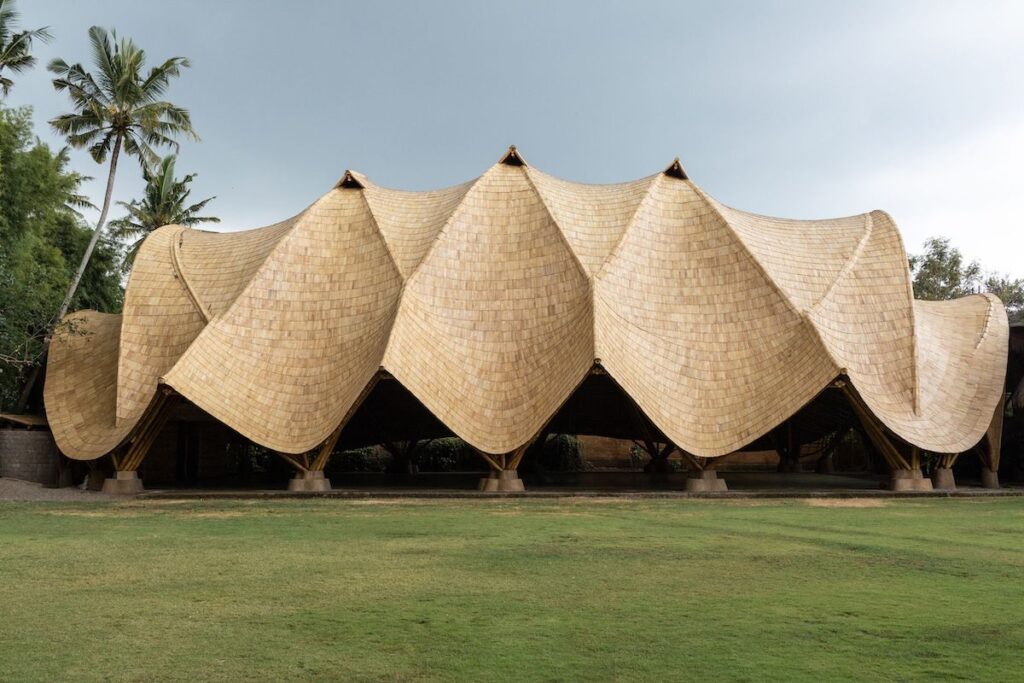
The Bamboo Sports Hall in the Philippines, presented in our header image, is an example of a structure that has been constructed fully using structurally engineered bamboo. The sports hall is a large, multi-purpose structure that can accommodate basketball, volleyball, and other indoor sports. The use of engineered bamboo allowed for the creation of a building that is not only sustainable and durable, but also aesthetically striking.
In conclusion, bamboo is an attractive and viable option for contemporary construction projects. Its sustainability, durability, and versatility make it a compelling choice for architects, designers, and builders seeking eco-friendly building solutions. The additional processing of bamboo into Structural Engineered Bamboo ensures the full exploitation of this material by widening the scope in which the material can be utilised. While there are challenges associated with using bamboo, these can be overcome through responsible sourcing and continued research and innovation. With its many benefits, it’s clear that bamboo has a bright future as a contemporary construction material.


Thank you very much for your comments and compliments. Am glad I can contribute positively towards a better understanding on the built environment.
Thank you. I would love to hear from you on some suggestions for my next pieces. Kindly write to me via blog@afsahara.co.ke. I will gladly consider them.